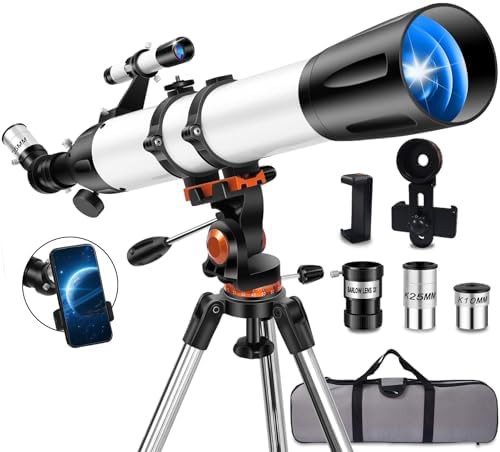
Large Aperture
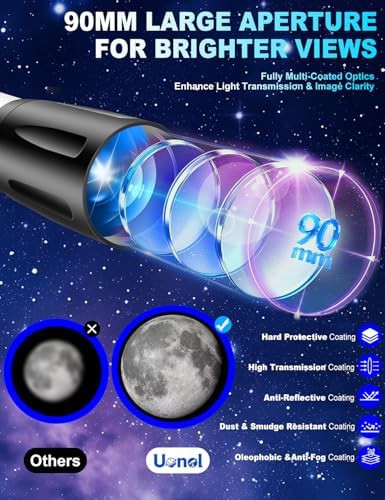
The 90mm opening captures more light for brighter images.
These high-powered refractor models provide clear views for adults looking to explore the night sky with significant light-gathering capability
The 90mm opening captures more light for brighter images.
An 800mm length offers steady magnification for deep viewing.
The glass lens system ensures sharp and reliable clarity.
This set focuses on a 90mm aperture and 800mm focal length to deliver detailed observations. The refractor design is built specifically for adult users who need more power from their optics.
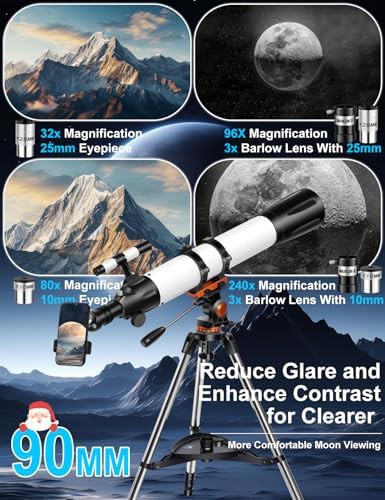
This Uonol set is built around For adults, Refractor telescopes, 90mm aperture, 800mm focal length.
Uonol keeps the build language in the product names: High power refractor with 90mm aperture.
The range is aimed at the uses named in For adults, Refractor telescopes, 90mm aperture, 800mm focal length, not a catch-all.
Start with High power refractor with 90mm aperture and match the listed type to what you need.
Ranges 800mm focal length 90mm aperture
The 90mm aperture makes a huge difference when looking at the moon and planets.
I appreciate the 800mm focal length for getting a much closer look at distant stars.
As an adult getting back into astronomy, this refractor is exactly the power level I needed.
These are refractor telescopes that use glass lenses to gather and focus light. This specific model features a 90mm aperture and an 800mm focal length.
This set is specifically designed for adults. The high-powered optics are suited for those who want a more serious tool for astronomy.
The 90mm aperture allows for significant light collection. This results in brighter and clearer images of celestial bodies compared to smaller lenses.
While it is a refractor, the 800mm focal length makes it a substantial piece of equipment. It is built for high-powered observation rather than ultra-light travel.